Two decision models on an American backbone
Base Labs, the research arm behind Baseten's Model APIs, released bison-1 and groundhog-1 on November 20. Both are decision models post-trained from Google's Gemma 4, and both are now available on AnyRouter through a BYOK System One route on Baseten.
A decision model does not write an answer. You give it a state and a set of named questions, and it returns a typed result for each one: a chosen option, a yes/no probability, or a score. That makes it useful for routing, classification, policy checks and rubric scoring, where you want a probability you can threshold rather than prose you have to parse.
| Model | Backbone | Parameters | Context | Price per 1M input |
|---|---|---|---|---|
| Bison 1 | Gemma 4 31B | 31B | 128K | $0.10 |
| Groundhog 1 | Gemma 4 26B-A4B | 26B (about 4B active) | 128K | $0.035 |
Both accept text and images in the state. The 128K context is eight times the window on the previous generation, which matters when the detail that changes a decision is buried in a long policy or conversation history.
How accurate are they?
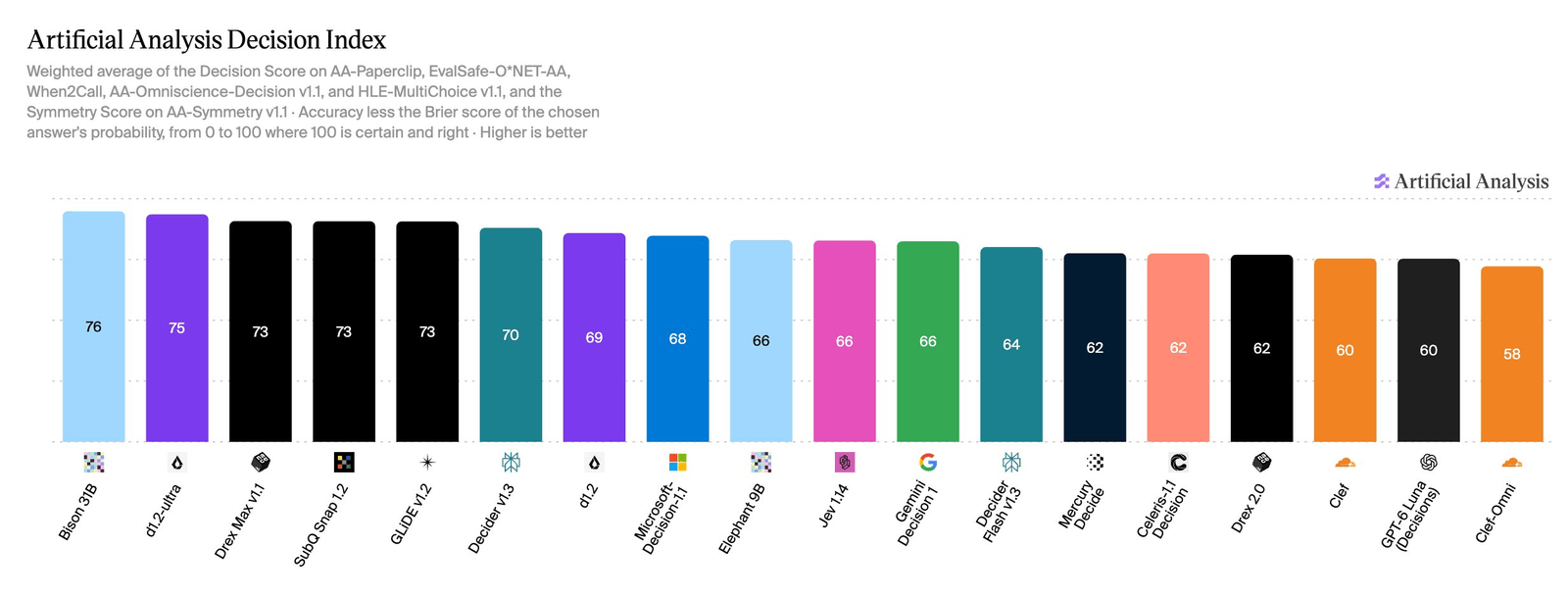
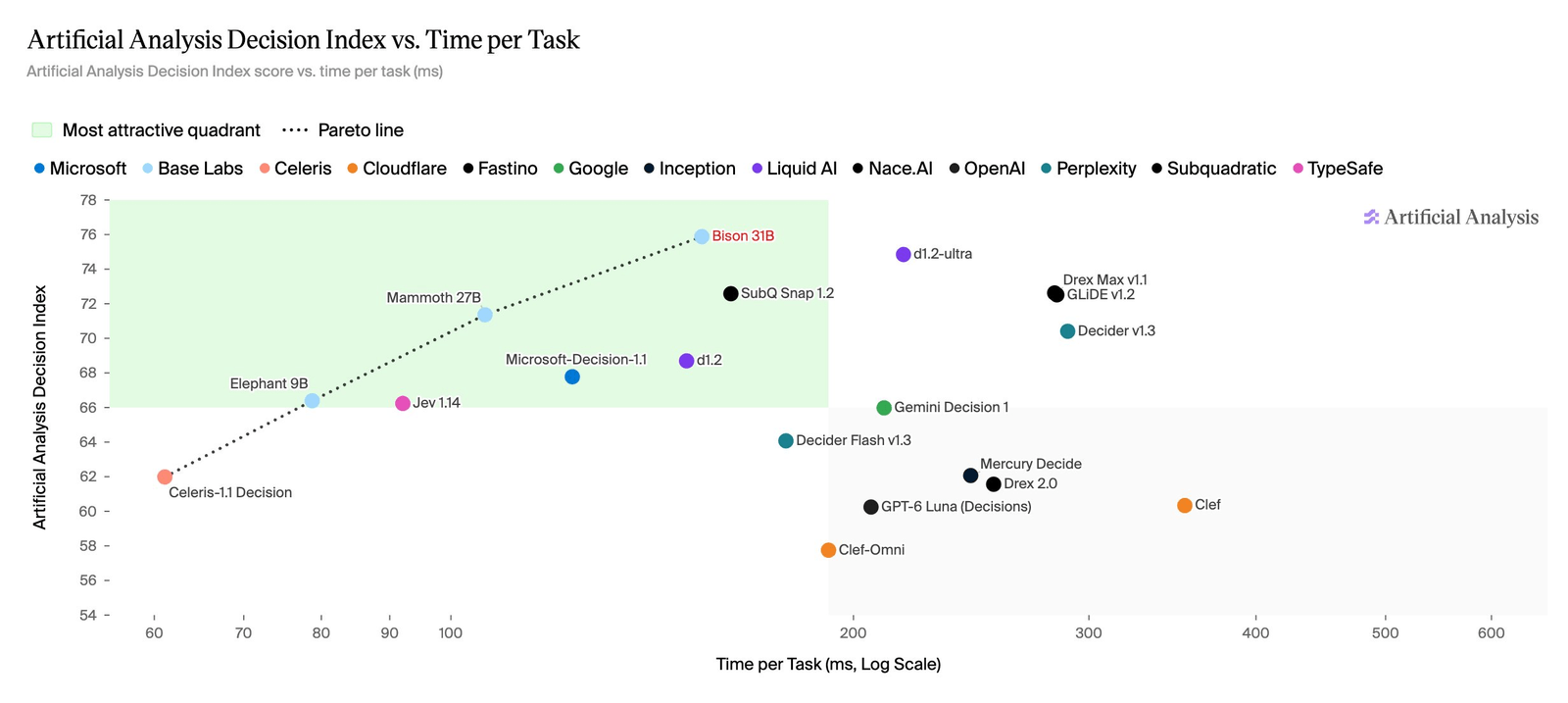
On the independent decision index v2.1, bison-1 ranks first of 19 decision models with a score of 76, ahead of d1.2-ultra at 75 and mammoth-1 at 71. It also has the lowest Brier score on the index at 0.14, so the confidence it reports is close to how often it is actually right. Baseten expects groundhog-1 to match mammoth-1 on the official index, but did not publish a score at launch.
Independent decision index v2.1
Scores published in the Baseten launch post.
Use them on AnyRouter
Both models are BYOK-only. Add a Baseten API key under Dashboard → BYOK and Baseten bills your own account; AnyRouter charges nothing for the route. The model ids are baselabs/bison-1 and baselabs/groundhog-1.
anyr decision --model "baselabs/bison-1"anyr decision --model "baselabs/groundhog-1"Under the hood the call posts {model, state, questions} to Baseten's native /v1/systemone endpoint. Question types are choice, noul for yes/no, and score against a rubric. Each answer includes its probability and, for choice and score, a confidence value.
What they are not
These are structured classifiers, not chat models. They do not hold a conversation or write long-form text. Baseten also notes that the image URLs accepted by the API must be base64 data URLs or objects from Amazon S3, Google Cloud Storage or Azure Blob Storage.
Route your first request in 2 minutes
Start free with your own keys, or top up and pay per token. Get $4/mo in credits and free models on Go — $2/mo, or free when you donate a provider key.