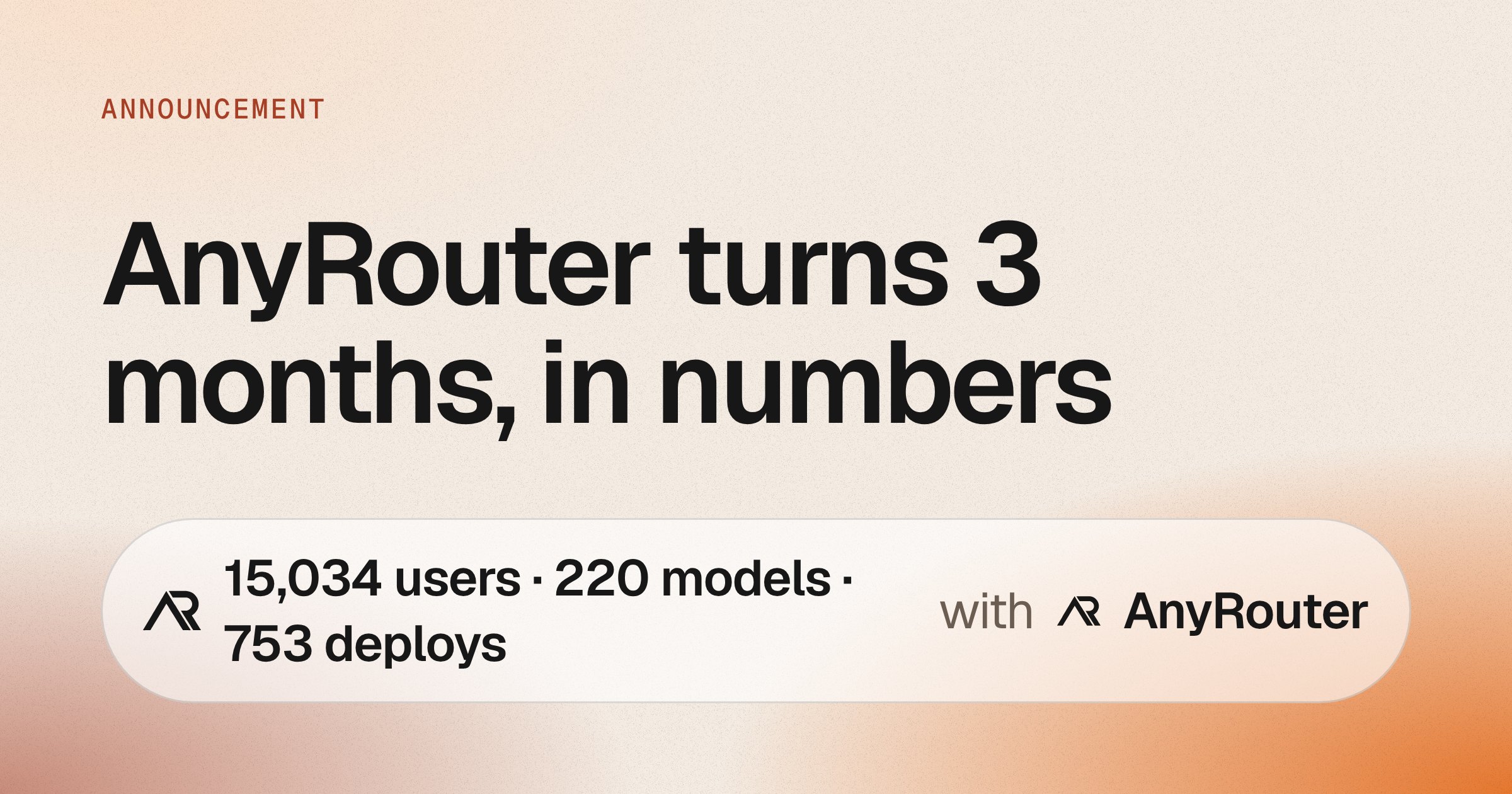
Three months, one page of numbers
AnyRouter is one API key that reaches every model. We call it three months old. That age is our framing, not a measured launch date: the first commit is from April 11 and the first signup from April 16. Every number below covers August 5 to November 4, 2026 unless it says otherwise.
The film is 75 seconds. It carries the same figures as this post.
The same figures as one page with charts, published as an AnyRouter Artifact. It runs no script and loads nothing from another site.
Open the metrics pageUsers
AnyRouter had 15,034 users on November 4, up from 1,695 on August 4. That counts accounts that were not banned. 5,966 people used it in the last 30 days (October 6 to November 4), and the busiest day, October 26, had 2,288.
Most of the growth came in one week. Between October 24 and October 27, 9,048 accounts signed up. We have no launch post to point at, so we make no claim about the cause.
Signups per month
Gross, before removing banned accounts. November covers days 1 to 5.
Models
We added 220 models between August 5 and November 4. That is more than two a day. On November 7 the catalog lists 376 models, and 42 of them are free on the Go plan.
Our catalog pipeline found at least 56 of the 220 on its own, from monitor tickets and catalog jobs. That figure is a lower bound. Every commit is authored by the same two accounts, so the author field cannot split pipeline work from hand work, and the other 164 are not labelled as hand-added.
Traffic
In the last 30 days AnyRouter served 1,340,987 requests and 65,530,955,527 tokens. We give traffic for 30 days only. Usage rollups start in October, so there is no honest request or token total for the whole three months.
How it gets built
anybot is our name for the AI agent fleet that works on the repository. These counts cover August 5 to November 4.
| What | Count | How it was counted |
|---|---|---|
| Commits to main | 4,506 | git history, UTC day boundaries |
| Pull requests merged | 3,435 | merged date, GitHub |
| Commits naming an AI co-author | 2,278 | Co-authored-by trailers, so a floor for AI involvement |
| Deploys | 753 | one machine's deploy log, 59 on the busiest day (October 31) |
| Issues filed | 2,663 | 2,614 closed for any reason |
| Issues filed by monitors | 863 | 851 closed, 465 of them completed |
The way this loop runs is the subject of how AnyRouter ships through agents. Since November 3 we land work as commits on main instead of pull requests, so the pull request count stops there.
What these numbers do not say
- Users are accounts, not paying customers. We show no revenue, credits or per-user data.
- The deploy count is from one machine's log, so it can only be too low.
- The October jump is real, but we do not know why it happened.
- Three months is our framing of the age, not a launch date.
Try it
One key, every model. Free models need the Go plan or a donated key, and the plan and pool rules are on the pricing page. Start at anyrouter.dev.
Related posts
How agents ship AnyRouter: the merge and deploy loop
Coding agents write, review, merge and deploy most AnyRouter changes. In the week of 19 to 25 October 2026 that loop merged 346 pull requests. This first post in the series shows the loop: a signed local CI gate, one reviewer per commit, one merge script, and gated deploys about once an hour.
Introducing AnyRouter Artifacts: publish a page, get a link
Artifacts turn an HTML page, a Markdown note, a Mermaid diagram or a small folder into a URL at anyrouter.dev/a/<id>. Publish from the anyr CLI, the API or an agent. Every artifact starts private, and you choose when to share it.
How agents deploy AnyRouter: one Worker at a time
AnyRouter runs as a fleet of Cloudflare Workers, and agents deploy it about once an hour from more than one machine. Each Worker now records the commit it runs, a deploy ships only the Workers whose code changed since that commit, and a checkout that is older than production cannot replace it. This post shows how that works and what it still costs.
Route your first request in 2 minutes
Start free with your own keys, or top up and pay per token. Get $4/mo in credits and free models on Go — $2/mo, or free when you donate a provider key.
Start free