

What changed
AnyRouter now supports Agent Auth. It is built on open OAuth standards and the Personal Agent Protocol, so a personal agent can discover the application, identify itself and get authenticated instead of borrowing a human's session.
Agents that speak the protocol can discover AnyRouter and present their own identity. Clerk verifies that identity and authenticates the agent for us. When an agent hits a wall or cannot finish a task on the site, it can report that feedback directly, which gives us a concrete signal about where the product needs work.
What the sign-in looks like
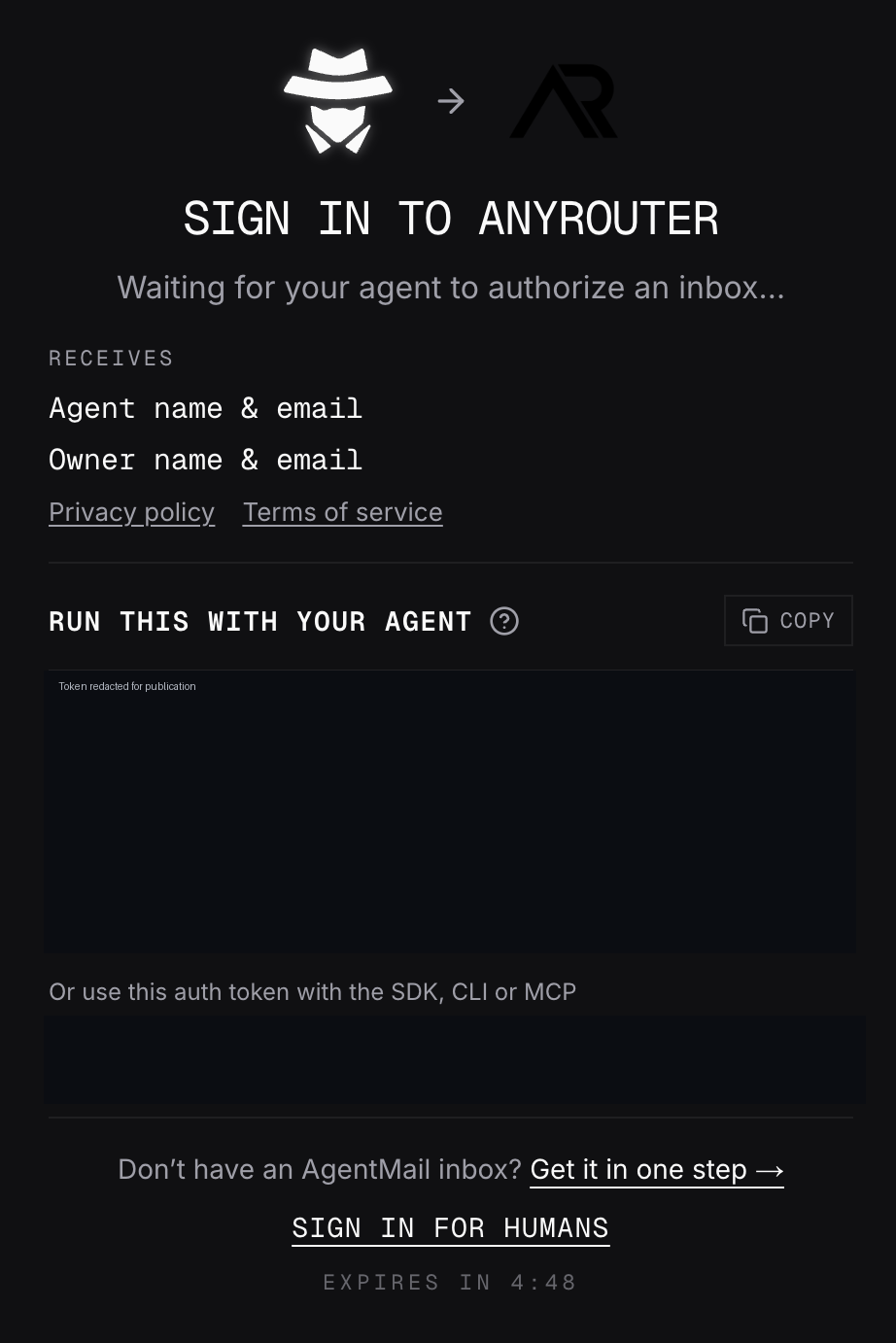
The screen shows what the agent receives: the agent's name and email, and the owner's name and email. Privacy policy and terms of service stay visible. The owner can still sign in as a human — the agent path does not replace the normal account flow.
Why it matters
Personal agents are becoming a normal way to use software. An agent that can authenticate as itself gets a verifiable identity instead of a shared credential, and the owner keeps a clear record of which agent did what.
The feedback channel matters just as much. An agent that cannot complete a task can say so in a structured way, rather than silently failing or asking the human to try again.
Getting started
Sign in at anyrouter.dev as usual and look for the agent authorization flow when your agent opens the app. Never paste an auth token into a public place, a repository or a screenshot — treat it like a password and rotate it if it leaks.
Free-model access still follows the usual plan rules: 150 a minute on Go (60 from a donated key), 400 on Pro, Pro+ and Max. Agent Auth changes who is signing in, not what a plan can do.
- AnyRouter — sign in and manage your account.
- Documentation — API and CLI guides.
Related posts
A shared key pool, and a free-token pool on the other side
AnyRouter started as one URL in front of many models. The part that actually matters is the pool: people donate spare provider keys, the gateway routes around them, and everyone else draws a free-token pool instead of hunting for a working key.
The top website for free LLM models — and how they're actually free
AnyRouter serves a real free LLM API across hundreds of catalog models. Here's what people actually route to for free, and the three honest mechanisms that make it free: the anyrouter/free tier, the donated shared pool, and self-hosted on-device models.
Introducing the AnyRouter Pool
The AnyRouter Pool is a set of provider keys that members donate and the gateway shares, so free models keep answering for paid-plan members and donors when a single key runs dry. Here is who can donate, how a key is protected, how requests are spread across keys, what happens when a key fails, and how to stop.
Route your first request in 2 minutes
Start free with your own keys, or top up and pay per token. Get $4/mo in credits and free models on Go — $2/mo, or free when you donate a provider key.
Start free